Add your promotional text...

Common AI Terms Every Beginner Should Know: A Simple Guide to Understanding Artificial Intelligence
Confused by AI terms like machine learning, prompts, chatbots, generative AI, and large language models? This beginner-friendly guide explains the most common artificial intelligence terms in simple language to help you understand how AI works and how it is used in everyday life.
• HOW AI HELPS EVERYDAY LIFE
AJ Sterling
6/30/20264 min read
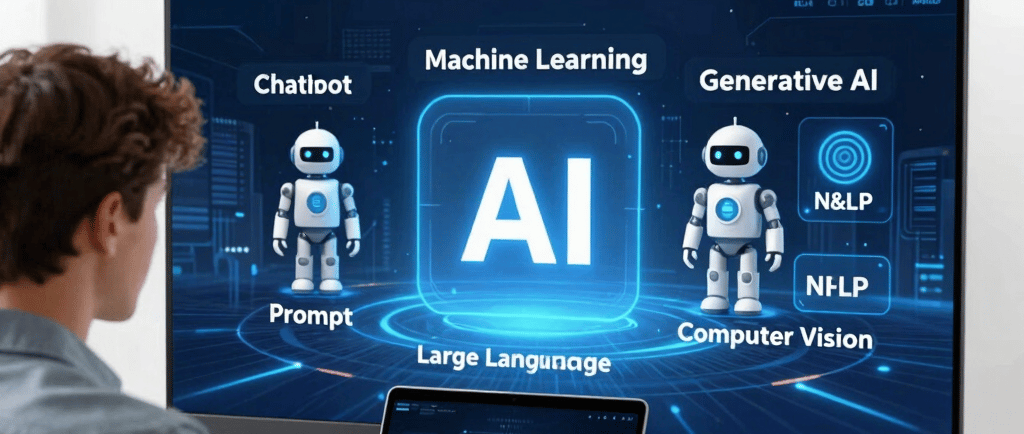

Common AI Terms Every Beginner Should Know: A Simple Guide to Understanding Artificial Intelligence
Artificial intelligence is everywhere today. It helps people write emails, create images, answer questions, build websites, plan trips, and even solve everyday problems. Yet many beginners feel confused because AI comes with a long list of technical words and acronyms.
When I first started using AI tools, I often saw terms like machine learning, prompts, chatbots, and large language models. At first, these words sounded complicated. The good news is that most AI terms are much easier to understand than they seem.
In this guide, I will explain some of the most common AI terms in simple language so anyone can understand them.
What Is Artificial Intelligence (AI)?
Artificial Intelligence, often called AI, is technology that allows computers to perform tasks that normally require human intelligence.
Examples include:
Answering questions
Recognizing images
Understanding speech
Creating content
Solving problems
AI is not a robot taking over the world. In most cases, it is simply software designed to help people complete tasks more efficiently.
For a deeper introduction, read our article: What Is Artificial Intelligence and How Does It Work?
What Is Machine Learning?
Machine Learning is a branch of AI that allows computers to learn from data.
Instead of programming every rule manually, developers provide examples and data. The system studies patterns and improves its performance over time.
Examples include:
Email spam filters
Product recommendations
Fraud detection systems
Video streaming suggestions
Many modern AI tools use machine learning behind the scenes.
What Is Generative AI?
Generative AI is a type of artificial intelligence that creates new content.
It can generate:
Articles
Images
Videos
Music
Computer code
Popular AI tools use generative AI to help users create content much faster than traditional methods.
What Is a Large Language Model (LLM)?
A Large Language Model, often called an LLM, is an AI system trained using enormous amounts of text.
LLMs help power many modern AI assistants.
They can:
Answer questions
Summarize information
Explain concepts
Write content
Generate ideas
These systems predict the most likely words to respond with based on what they learned during training.
What Is a Prompt?
A prompt is simply the instruction you give to an AI system.
Examples:
"Write a blog post about gardening."
"Explain artificial intelligence."
"Create a social media caption."
The quality of your prompt often affects the quality of the AI's response.
Learning how to write clear prompts is one of the most valuable AI skills today.
What Is a Chatbot?
A chatbot is software that communicates through conversation.
Many businesses use chatbots to:
Answer customer questions
Provide support
Schedule appointments
Share information
Modern AI chatbots are much more advanced than older automated systems because they can understand natural language more effectively.
What Is Natural Language Processing (NLP)?
Natural Language Processing, or NLP, helps computers understand human language.
NLP allows AI systems to:
Read text
Understand speech
Translate languages
Analyze conversations
Without NLP, AI assistants would struggle to communicate with people.
What Is AI Training?
AI training is the process of teaching an AI system using large amounts of information.
During training, the AI studies data and learns patterns that help it perform tasks.
The quality of training data plays a major role in how useful and accurate an AI system becomes.
What Is an AI Hallucination?
An AI hallucination happens when an AI system generates information that sounds correct but is actually inaccurate.
This is one reason users should always verify important information.
AI can be a powerful assistant, but it should not replace critical thinking or fact-checking.
What Is Automation?
Automation is the use of technology to perform tasks automatically.
Examples include:
Sending emails automatically
Scheduling social media posts
Generating reports
Managing repetitive business tasks
AI and automation often work together to save time and improve productivity.
What Is Deep Learning?
Deep Learning is an advanced form of machine learning that uses structures called neural networks.
Deep learning helps power:
Voice assistants
Image recognition
Self-driving technology
Advanced AI systems
Although the technology behind it is complex, its purpose is simple: helping computers learn patterns from large amounts of information.
What Is Computer Vision?
Computer Vision allows AI systems to understand images and videos.
Examples include:
Facial recognition
Medical image analysis
Security cameras
Self-driving vehicle systems
Computer vision helps machines interpret visual information much like humans do.
Quick AI Terms Reference Guide
AI TermSimple MeaningArtificial IntelligenceComputers performing intelligent tasksMachine LearningAI that learns from dataGenerative AIAI that creates contentLarge Language ModelAI trained using massive amounts of textPromptInstructions given to AIChatbotAI that communicates through conversationNLPAI understanding human languageAI TrainingTeaching AI using dataHallucinationIncorrect information generated by AIAutomationTasks completed automaticallyDeep LearningAdvanced machine learning methodComputer VisionAI understanding images and videos
How These AI Terms Work Together
Think of AI as a large toolbox.
Machine Learning and Deep Learning are tools inside that toolbox.
Natural Language Processing helps AI understand language.
Computer Vision helps AI understand images.
Generative AI creates content.
Large Language Models power many AI assistants.
Prompts help people communicate with AI systems.
Together, these technologies allow AI to assist people in ways that were impossible only a few years ago.
Final Thoughts
Artificial intelligence may seem complicated at first, but learning a few key terms makes it much easier to understand.
Whether you are a business owner, website creator, student, or simply curious about technology, understanding these basic AI concepts can help you make better decisions and use AI more effectively.
The AI industry continues to evolve rapidly, but the fundamentals remain important. Once you understand these common terms, you will be much more comfortable exploring new AI tools and technologies.
Continue Learning
At Orlando AI Marketing, our goal is to make artificial intelligence easy to understand and practical for everyday life.
Stay Updated with AI News & Tools
contact@orlandoaimarketing.com
Support Our Work
Help us continue creating AI news, guides, and educational content


Some links in this article are affiliate links. If you make a qualifying purchase through them, we may earn a commission at no additional cost to you.
🌐 Like this website?
🚀 Let us build one for you. Whether it's for your business, organization, or personal project, visit our Website Building page and see how we can bring your ideas online.